Same Seat. Same Flight. Three Very Different Points Prices
One Virgin Upper Class award from ATL to London shows why the airline flying the plane can be the expensive place to book with points.


A flight can look simple until the points prices appear.
Same plane.
Same seat.
Same date.
Then the award shows up three different ways:
81,500 points + $245
350,000 points + $709
499,900 SkyMiles + $5.60
That is the same nonstop Virgin Atlantic Upper Class seat from Atlanta to London Heathrow.
Same aircraft.
Same cabin.
Same 8-hour flight.
The cash fare was showing at $17,322 round trip, which makes one direction roughly $8,661 using half the round-trip price as the benchmark.
This is an Atlanta example, but the lesson is much bigger than Atlanta.
The airline flying the plane, the airline whose points you have, and the place where the award prices best can all be different.
By the end of this post, I’ll show you why one of the most expensive points mistakes is earning for the airline name on the plane instead of earning points that can reach the best pricing source.
The seat is the same. The points bill is the trap.
The ATL-LHR screenshot that explains the problem
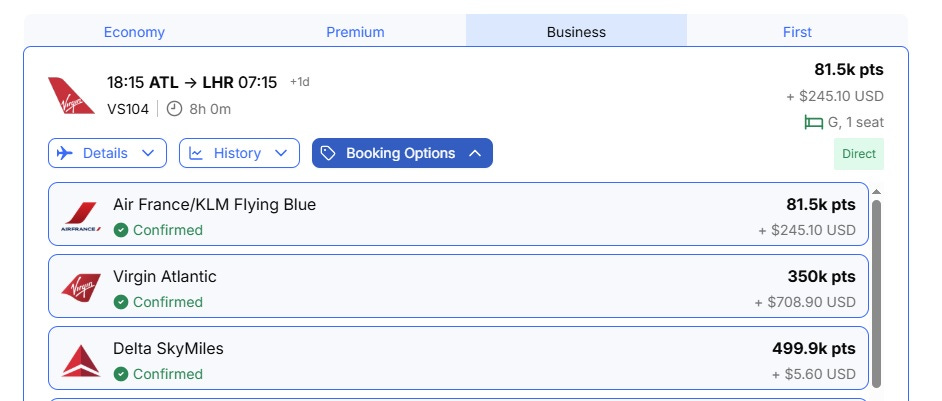
This is where award travel starts feeling unfair.
Most travelers would look at a Virgin Atlantic Atlanta to London flight and expect the price to make basic sense.
They might check Virgin Atlantic.
They might check Delta SkyMiles.
They might assume the airline flying the plane should have the cleanest price.
Then the actual numbers show up.
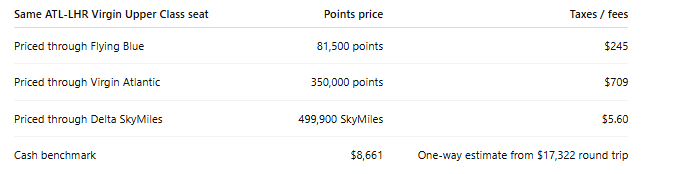
That is a wild spread.
The Flying Blue price is less than one-fourth of the Virgin Atlantic price and about one-sixth of the Delta SkyMiles price.
The Delta version looks deceptively clean because the taxes are only $5.60.
That tiny fee can make the wrong booking feel less painful than it really is.
A traveler sees low cash out of pocket and misses the giant points burn sitting right above it.
Low fees can hide an expensive business class award
This is the part that tricks people.
Delta shows 499,900 SkyMiles + $5.60 for the same Virgin Upper Class award seat.
That fee looks beautiful.
The points price is brutal.
A traveler with a huge SkyMiles balance may see that and think:
“At least the taxes are low.”
That is how the expensive door wins.
Low cash out of pocket can make a terrible points price feel emotionally easier. You feel like you are avoiding fees while spending hundreds of thousands of extra points for the same Upper Class seat.
That is especially painful when the program feels familiar.
The familiar website creates trust.
The familiar balance creates comfort.
The low fee creates relief.
Then the points price drains the account.
Low taxes can distract you from a bad points price.
The airline on the plane is only part of the story
This flight is operated by Virgin Atlantic.
That detail helps identify the seat.
Virgin Atlantic still prices the award far above the Flying Blue option in the screenshot.
Delta SkyMiles prices even higher, despite the Delta and Virgin partnership.
Award travel is stranger than most travelers expect.
The airline flying the plane, the airline selling the cash ticket, the loyalty program pricing the award, and the points you have in your account can all point in different directions.
That is why the same ATL to London Virgin Upper Class seat can show up as:
81,500 points
350,000 points
499,900 SkyMiles
The seat stayed the same.
The pricing source changed.
That one difference can decide whether a traveler books a reasonable business class award to Europe or burns a mountain of points for the same experience.
“I have points” is incomplete
A big balance feels safe.
Six figures of points feels even safer.
Half a million points can feel like power.
Then a screen like this appears.
If your points only reach the expensive price, your balance may be less useful than it looks.
That is the frustration.
A traveler can have enough points in the wrong place and still have a worse outcome than someone with fewer points in the right place.
That feels ridiculous.
It is also how award pricing works.
The best balance is rarely the biggest one.
The best balance is the one that gives you access to the better price.
Your home airport can train the wrong habit
Every airport teaches travelers a default habit.
Atlanta travelers are trained to check Delta first because Delta dominates the airport.
West Coast travelers have their own version of this.
Smaller-market travelers have another.
The habit changes by airport, but the mistake is the same: people check the obvious program and assume the price they see is the real price.
That can get expensive fast.
A traveler may spend years building the balance that feels natural at their home airport, then finally search for Europe business class awards and find the points version of a locked door.
The cash ticket may be expensive.
The operating airline’s own points price may be ugly.
The familiar program may ask for an absurd number of miles.
Meanwhile, the better answer may sit one step away from the place they checked first.
That is why this example matters.
It is more than a London example.
It is a warning about earning strategy, search habits, and the danger of assuming the obvious website gives the best answer.
The fee trade is real
The 81,500-point ATL-LHR award has higher taxes than Delta’s $5.60 version.
That deserves a plain comparison.
Would you rather spend:
81,500 points + $245
or
499,900 SkyMiles + $5.60
For many travelers, the answer gets clear once the numbers sit side by side.
The extra $239.40 in cash may save 418,400 points.
That is the kind of trade that can completely change a trip.
Those extra points could support hotels, domestic positioning flights, another traveler, another trip, or future travel flexibility.
And this is before comparing against cash.
With a one-way cash benchmark of roughly $8,661, the 81,500-point version changes the whole conversation. It turns a cash fare that would stop most travelers cold into a lie-flat seat that can actually be considered.
This is why fees need context.
The question is:
What are the fees protecting you from?
In this case, the fee may protect you from a catastrophic points burn or a painful cash fare.
The expensive answer can still feel familiar
The expensive answer often feels safe because it comes from the place you already know.
That is the danger.
A familiar website can create trust.
A familiar points balance can create comfort.
A familiar airline can make the booking feel easier.
Then the numbers punish the habit.
The better Virgin Upper Class award price may require checking a place you do not normally use. It may require points that transfer differently. It may require understanding that the operating airline and the best pricing source can be separate.
That extra layer of knowledge is annoying.
It can also be worth hundreds of thousands of points.
The easiest place to search is rarely the best place to book.
This is the same lesson as cheap domestic awards
I wrote recently about points prices remaining low despite rising cash prices for summer 2026 domestic awards from Atlanta
That post had a simple lesson:
The first cash price is rarely the final answer.
This Atlanta to London Virgin Upper Class example is the premium-cabin version of the same idea.
A domestic economy seat can price differently depending on where the award is priced.
A lie-flat business class seat to Europe can do the same thing, with much bigger stakes.
A bad domestic booking might waste a few thousand points.
A bad international business-class booking can waste hundreds of thousands.
The Part That Decides the Price
The valuable points are the ones that let you choose the best pricing source, regardless of which airline is painted on the plane.
Airline loyalty is easy to understand.
Pricing-source flexibility is where the leverage lives.
A traveler earning only toward the familiar program may still get the seat, but at the worst price on the board.
A traveler with points that reach the better pricing source may book the same Virgin Upper Class seat for a fraction of the points.
Same plane.
Same seat.
Same date.
Different outcome.
That is the difference between collecting points and having useful points.
The Question Most Travelers Ask Too Late
Before assuming you have enough points for Europe business class, ask these questions.
Can your points reach the program pricing the seat best?
Are you checking only the airline operating the flight?
Are low taxes distracting you from a brutal points price?
Would paying a few hundred dollars in fees save hundreds of thousands of points?
Does your earning plan give you options, or did it back you into the expensive door?
That last question is the one most travelers answer too late.
They search after the points are already earned.
They discover the better price after the balance is already built somewhere else.
They learn that the seat was available all along.
Their points just reached it the expensive way.
That is why this ATL-LHR Virgin Upper Class example is worth staring at.
The flight is simple.
The pricing is the trap.
And in award travel, the pricing source can be the whole game.